
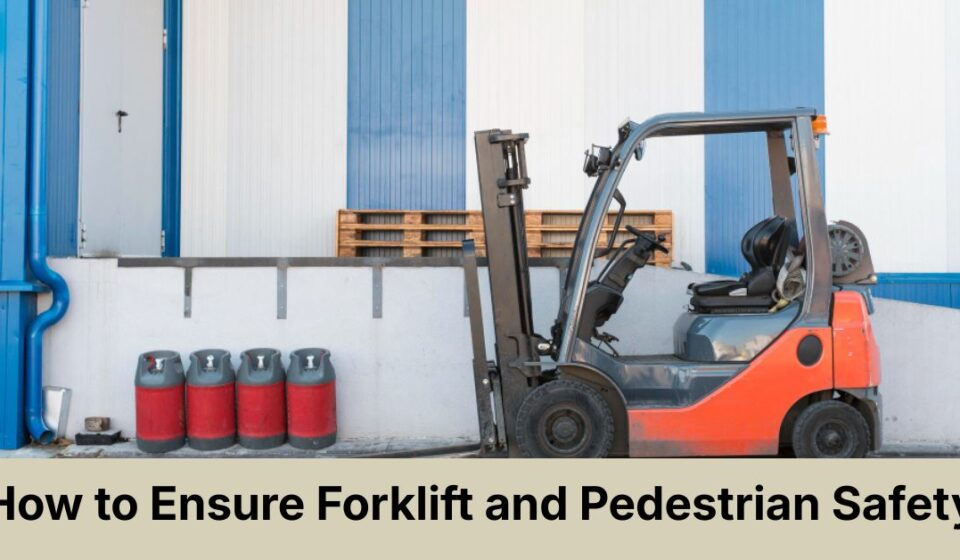
Forklift and Pedestrian Safety: Separation Zones, Speed Limits & OSHA Rules

Powered Industrial Trucks (forklifts) are indispensable workhorses in warehousing and logistics, but they pose extreme hazards to ground pedestrians. Weighing up to three times more than a standard passenger vehicle with rear-wheel pivot steering and obstructed forward mast visibility, forklift-pedestrian impacts frequently result in fatal crush injuries or amputations.
Direct Safety Takeaway: Under OSHA Standard 29 CFR 1910.178, forklifts must yield the right-of-way to pedestrians, maintain safe travel speeds (typically 5 mph indoors), and sound horns at all blind intersections. Pedestrians must maintain a minimum 3-meter (10-foot) safety perimeter around operating forklifts and never assume the driver sees them.
Top 4 Forklift & Pedestrian Incident Scenarios
| Accident Scenario | Root Hazard Mechanism | Mandatory Engineering / Operational Control |
|---|---|---|
| Rear-End Swing Collisions | Rear-wheel steering causes counterweight to swing wide rapidly during turns. | Maintain 3-meter clearance; install projected LED red perimeter halo lights on floor. |
| Blind Intersection Strikes | Pedestrians walking into cross-aisles where high rack storage blocks driver view. | Install convex ceiling mirrors, stop signs, and auto-sounding horn sensors. |
| Crush Against Fixed Objects | Pedestrian pinned between forklift counterweight and a pallet rack or wall. | Never stand between a moving forklift and a fixed barrier; designate pedestrian walkways. |
| Falling Elevated Loads | Pedestrians walking underneath or near elevated forks and pallets. | Strictly prohibit walking under raised forks; enforce mast tilt limits during travel. |
The 5 Rules of Forklift & Pedestrian Interaction
- 1. Make Direct Eye Contact: Never walk near or cross in front of a forklift until you make direct eye contact with the operator and receive a clear hand wave confirmation.
- 2. Separate Pedestrian & Forklift Pathways: Paint bright yellow pedestrian walkways and erect heavy-duty steel safety barriers separating foot traffic from forklift aisles. (See Parking Lot & Yard Safety).
- 3. Sound Horns at Every Blind Corner: Forklift operators must slow down, tap the horn twice, and scan convex mirrors before traversing doorways or intersections.
- 4. Travel with Forks Low: Forklift forks must be kept 4 to 6 inches above the floor with the mast tilted back during travel to maximize stability and forward visibility.
- 5. Wear High-Visibility PPE: All personnel and visitors entering warehouse or yard zones must wear ANSI Class 2 or Class 3 high-visibility fluorescent vests.
5-Minute Safety Talk / Toolbox Topic: Forklift Blind Spots
- Meeting Question: “If you are carrying a large load on your forks that completely blocks your forward view, what must you do?” (Answer: Travel in reverse with your head turned looking in the direction of travel).
- Walkaround Check: “Verify that our warehouse aisle convex mirrors are clean and unobstructed.”
- Supervisor Note: “Never step inside the rear-end swing radius of a turning forklift—the counterweight swings out faster than you can step back.”
Warehouse Forklift & Pedestrian Safety Checklist
- ☐ Dedicated pedestrian walkways clearly painted and unobstructed by pallets.
- ☐ Convex mirrors clean, aligned, and mounted at all blind corners and intersections.
- ☐ Forklift travel speed limits (5 mph) posted and enforced throughout facility.
- ☐ Backup alarms, strobe beacons, and blue floor spotlight projectors operational.
- ☐ Daily pre-shift forklift inspection checklists completed by certified operators.
- ☐ High-visibility vests worn by 100% of workers and visitors on warehouse floor.
Frequently Asked Questions
Can a pedestrian ever ride on a standard forklift?
Strictly prohibited. OSHA prohibits passengers on forklifts unless the manufacturer has provided an engineered, factory-approved passenger seat equipped with a seatbelt and rollover protective structure (ROPS).
Authoritative Sources & Standards
- OSHA 29 CFR 1910.178: Powered Industrial Trucks.
- NIOSH Alert: Preventing Injuries and Deaths of Workers Who Operate or Work Near Forklifts (Pub. No. 2001-109).
- ANSI/ITSDF B56.1: Safety Standard for Low Lift and High Lift Trucks.



[…] Read more: How to Ensure Forklifts and Pedestrians Safety […]